

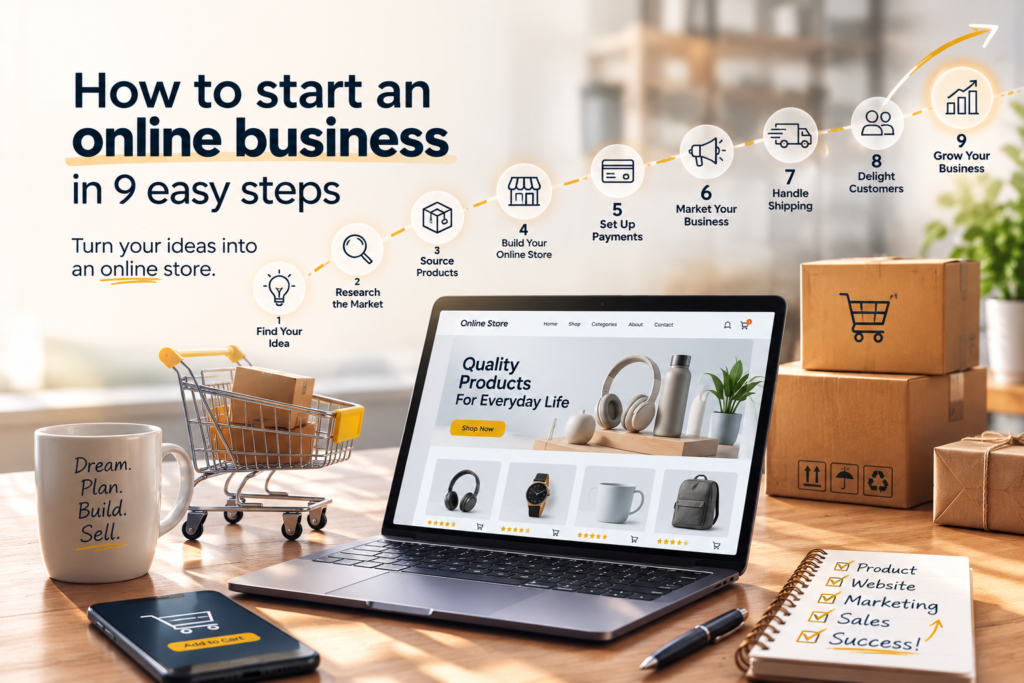
How to start an online business in 9 easy steps
Mar
How to Start an Online Business in 9 Simple Steps
Starting an online business has never been more accessible. Whether you want to launch an online store, offer digital services, sell through online marketplaces or create your own products, a digital business can often be built with relatively manageable start-up costs.
However, launching a successful online business involves more than creating an attractive website. You need a valuable offer, a viable business model, realistic financial calculations, appropriate legal structures and a clear customer acquisition strategy.
This guide explains how to build an online business in Germany in nine practical steps.
Please note: This article provides general information for starting a business in Germany. It does not replace individual legal, tax or professional business advice.
Step 1: Find a Specific and Profitable Business Idea
Every business starts with an idea. However, an interesting idea is not automatically a viable business opportunity. Your offer must solve a real problem or satisfy a clearly identifiable customer need.
An online business may be based on models such as:
- selling physical products through an online store
- selling surplus stock, customer returns or clearance goods
- selling through marketplaces such as Amazon, eBay or Etsy
- digital products such as e-books, templates or online courses
- consulting, coaching or agency services
- affiliate marketing
- subscription and membership models
- software and platform-based services
Define your idea as precisely as possible. Instead of saying, “I want to sell products online,” determine exactly what you want to sell, who your customers are and why they should purchase from your business.
A useful question is:
Which problem do I solve for which customer, and why is my solution better or more attractive than the available alternatives?
Research whether genuine demand already exists. Study competing products, search trends, customer reviews and online discussions. Negative reviews are particularly valuable because they often reveal weaknesses in existing offers and potential gaps in the market.
Avoid spending months developing an idea without testing it. A simple landing page, a small product selection or a limited initial service can provide more useful information than extensive theoretical planning.
Step 2: Define Your Target Audience and Analyse Your Competitors
The more precisely you understand your target audience, the more effectively you can design your products, pricing, marketing and customer service.
A target audience should not be defined solely by age, income or location. Customer needs, motivations, objections and purchasing behaviour are often more important.
Ask yourself:
- Who needs my product or service?
- Which problem is the customer trying to solve?
- What does the customer expect in terms of quality and service?
- Where does the customer look for information?
- Which arguments are likely to persuade the customer?
- Which concerns may prevent a purchase?
- How much is the customer willing to pay?
Use these answers to create a detailed customer profile.
For example, an online shop specialising in inspected customer returns and surplus goods may target price-conscious shoppers who want branded products at reduced prices while still expecting transparent information about each product’s condition.
Next, research your competitors. Analyse their:
- products and services
- pricing
- customer reviews
- websites
- search engine rankings
- delivery conditions
- social media presence
- strengths and weaknesses
The objective is not to copy another business. The purpose of competitor research is to understand what already works and where you can provide a better customer experience.
Potential competitive advantages include:
- attractive prices
- individually inspected products
- honest condition descriptions
- a carefully selected product range
- responsive customer service
- a strong sustainability message
- unique product bundles or mystery boxes
- useful buying guides and educational content
Your competitive advantage should be clear and relevant. A statement such as “We provide excellent quality” is too vague. A more convincing promise would be: “Every returned product is individually inspected and accurately described before it is offered for sale.”
Step 3: Create a Viable Business Model
A good idea is only the beginning. You must determine how the business will actually generate revenue and profit.
Your business model should cover:
- the product or service
- the target customer
- sales channels
- pricing
- cost structure
- suppliers and partners
- payment processing
- customer service
- revenue streams
Create at least a basic business plan. It does not need to be extremely long, but it should explain how you intend to operate, acquire customers and remain financially sustainable.
Do not calculate your prices based only on the purchase cost of a product. Online businesses may also incur expenses for:
- packaging
- warehousing
- payment providers
- shop software
- marketplace fees
- returns
- advertising
- accounting
- insurance
- tax advice
- product inspections
- complaints and refunds
- legal texts and professional advice
Your selling price should be based on a complete cost calculation. Include a reasonable financial buffer for unexpected expenses.
A product can generate significant revenue while still producing a loss. New online retailers frequently underestimate advertising costs, platform fees, returns, discounts and customer service expenses.
Establish measurable targets such as monthly revenue, average order value, profit margin, customer acquisition cost and repeat purchase rate.
Step 4: Choose a Business Name and Build Your Brand
Your business name forms an important part of the customer’s first impression. It should be memorable, understandable and easy to spell.
A strong business name should:
- match the business model
- be easy to pronounce
- avoid unnecessarily complicated spelling
- allow the business to expand into additional products
- be available as a domain and social media name
- avoid conflicts with existing trademarks
Before making a final decision, check whether similar business names or registered trademarks already exist. The availability of a domain does not automatically mean that the name can legally be used.
Secure the appropriate domain and relevant social media handles as early as possible.
You should then create a consistent brand identity, including:
- logo
- colours
- typography
- visual style
- tone of voice
- core brand message
Your branding should remain consistent across your website, emails, invoices, packaging and social media accounts. Consistency improves recognition and builds customer trust.
Step 5: Select the Appropriate Legal Structure and Register the Business
Before regularly offering products or services for profit, you must determine the legal structure under which your business will operate.
Common legal structures in Germany include:
- sole proprietorship
- civil-law partnership, known as a GbR
- entrepreneurial company with limited liability, known as a UG
- limited liability company, known as a GmbH
Your legal structure affects personal liability, taxation, bookkeeping, administrative responsibilities, required capital and the public image of the company.
Germany’s official business start-up portal explains that financial, tax-related and liability considerations should be evaluated when selecting a legal structure.
Many founders begin as sole proprietors because this structure is comparatively straightforward. However, the owner is generally personally liable for the company’s obligations.
A UG or GmbH may limit personal liability, but these structures involve more formal requirements, administrative work and expenses.
A commercial activity generally has to be registered with the relevant local trade office. This usually applies to online shops and may also apply when the business is operated on a part-time basis. Freelance activities are generally reported directly to the tax office instead.
Once the trade has been registered, information may be forwarded to other relevant authorities, including the tax office and the responsible accident insurance association. Additional registrations may be required depending on the legal structure and business activity.
You should also check whether your products or services require special licences, professional registrations or official approvals.
Step 6: Organise Taxes, Accounting and Insurance
After starting the business, you must register it for tax purposes.
In Germany, the tax registration questionnaire is generally submitted electronically through ELSTER to the relevant tax office. Once the information has been reviewed, the tax office issues the company’s tax number.
According to Germany’s official business start-up portal, the questionnaire generally has to be submitted within one month of opening the business or beginning a freelance activity.
The questionnaire includes information such as:
- legal structure
- type of business activity
- expected revenue
- expected profit
- bank details
- VAT treatment
- possible use of the small-business VAT scheme
The German small-business VAT scheme, known as the Kleinunternehmerregelung, is a tax arrangement. It is not the same as operating a small trade or Kleingewerbe.
Whether the scheme is suitable depends on your expected revenue, investments, purchases and customer base. A business that makes substantial purchases subject to VAT should examine the financial consequences carefully.
Set up proper accounting processes from the beginning. Keep personal and business payments separate wherever possible. A dedicated business bank account can make financial management and bookkeeping much easier.
Store invoices, receipts and other relevant records systematically. Online retailers should also maintain accurate records of inventory, purchases, returns and customer refunds.
Depending on the nature of your business, relevant insurance may include:
- public liability insurance
- professional indemnity insurance
- product liability insurance
- commercial contents insurance
- cyber insurance
- legal expenses insurance
Step 7: Build Your Website or Online Store
Your website is the digital storefront of your business. It should not only look professional but also be clear, fast, secure and easy to use.
You may build your online store using:
- a hosted e-commerce platform
- a website builder
- a content management system with an e-commerce extension
- a custom-developed solution
Important selection criteria include:
- ease of use
- monthly costs
- scalability
- mobile usability
- page speed
- payment options
- inventory management
- marketplace integrations
- legal customisation
- search engine optimisation
- backups and security
Design the website from the customer’s perspective. Visitors should immediately understand:
- what you sell
- why the product is valuable
- how much it costs
- what condition it is in
- how the ordering process works
- which payment methods are available
- how they can contact your business
Transparent descriptions are particularly important when selling customer returns, surplus goods or clearance products. Clearly describe visible signs of use, damaged packaging or missing accessories.
High-quality images and realistic descriptions build trust while reducing questions, disputes and returns.
Your website must also work properly on smartphones. Many customers shop through mobile devices, and poor navigation or confusing product pages can immediately cause them to abandon a purchase.
Step 8: Ensure That Your Online Business Meets Legal Requirements
A commercial website is subject to various legal requirements. Depending on the business model, these may include an imprint, privacy information, consumer information and a legally compliant ordering process.
Commercial digital services must provide the information required by Section 5 of Germany’s Digital Services Act in a way that is easily recognisable, directly accessible and permanently available.
The imprint requirement generally applies to online shops, commercial marketplace accounts and business-related social media profiles.
A German online shop may require:
- a complete legal notice or imprint
- a privacy policy
- clear prices and information about additional charges
- delivery and payment information
- delivery times
- cancellation instructions
- a model cancellation form
- general terms and conditions, when used
- a clearly labelled order button
- information about how the contract is concluded
- information about statutory warranty rights
- consumer dispute resolution information where applicable
- compliant use of cookies and tracking tools
- product safety and labelling information
- accessibility measures where applicable
Consumers entering into distance contracts generally have a 14-day right of withdrawal unless a statutory exception applies. The business must provide the required information regarding this right.
Since 19 June 2026, affected online retailers must also provide an electronic withdrawal function, commonly referred to as a withdrawal button.
Do not copy legal texts from another website without reviewing them. Different products, payment methods, marketing tools and business processes may create different legal requirements.
Where necessary, have your website reviewed by a qualified legal professional or use a professionally maintained legal text service.
Step 9: Launch Your Marketing and Start Acquiring Customers
An online business will not automatically attract visitors. Even an excellent website requires an effective customer acquisition strategy.
Important marketing channels include:
- search engine optimisation
- paid search advertising
- social media marketing
- email marketing
- partnerships
- influencer marketing
- referral programmes
- online marketplaces
- content marketing
- local advertising and business networks
Do not attempt to use every channel at once. Begin with one or two channels that are particularly relevant to your audience.
Search engine optimisation can help potential customers discover your business through Google and other search engines. In addition to product pages, publish content that answers genuine customer questions.
Useful content may include:
- buying guides
- product comparisons
- explanations of product conditions
- information about returns and surplus goods
- maintenance instructions
- frequently asked questions
Product descriptions should be both readable and search-engine-friendly. Use relevant search terms naturally and avoid excessive repetition.
Social media can be used to present products, introduce new arrivals, provide behind-the-scenes insights and establish trust. You might show product inspections, newly received stock or unique limited-availability items.
Email marketing can help turn first-time visitors into repeat customers. However, applicable consent and data protection requirements must be observed.
Measure your results continuously. Important performance indicators include:
- website traffic
- conversion rate
- average order value
- customer acquisition cost
- shopping cart abandonment rate
- return rate
- repeat purchase rate
- revenue
- contribution margin
- profit per order
Customer questions, complaints and reviews should be treated as valuable information. Repeated problems indicate where product descriptions, packaging, delivery, website usability or customer service should be improved.
Common Mistakes When Starting an Online Business
Many start-up problems are caused by incorrect priorities rather than a lack of motivation.
Planning for Too Long
An idea does not become more viable simply because it is developed in theory for several months. Launch a controlled initial version and improve it using real customer feedback.
Setting Prices Too Low
Low prices do not automatically produce more profit. Include all direct and indirect costs before determining your selling prices.
Underestimating Legal Requirements
Incorrect legal information, unclear prices or non-compliant advertising can be expensive. Legal requirements should be addressed before sales begin.
Failing to Create a Clear Positioning
A company that attempts to serve everyone may fail to become the preferred choice for anyone. A clear specialisation makes marketing and brand development easier.
Using Too Many Marketing Channels
More channels do not automatically generate better results. Focus on a limited number of activities and evaluate them using measurable data.
Mixing Personal and Business Finances
Unstructured payments make accounting, tax reporting and financial management unnecessarily difficult. A clear separation saves considerable time.
Neglecting Customer Service
Fast, professional and solution-oriented communication can turn a complaint into a positive customer experience and a long-term business relationship.
How Much Start-Up Capital Does an Online Business Need?
The required amount depends heavily on the business model.
A digital service may be started with relatively low initial expenses. An online store with its own stock may require capital for products, warehousing, packaging, technology, advertising and possible returns.
Do not calculate only the initial launch costs. Maintain sufficient liquidity to cover ongoing expenses because it may take several months before a new business generates stable revenue.
A realistic financial plan should include:
- formation and registration costs
- technical equipment
- website or shop software
- initial inventory
- packaging and storage
- insurance
- legal and tax advice
- marketing
- ongoing operating expenses
- potential tax payments
- refunds and complaints
- personal living expenses
Conclusion: Build Your Online Business One Step at a Time
Starting an online business is more accessible than ever, but long-term success requires more than a website and an interesting product.
A successful business needs a clearly defined target audience, a meaningful customer benefit, realistic financial planning, legally compliant processes and consistent marketing.
You do not need to master every aspect from the first day. Build a solid foundation, test your offer on a manageable scale and improve your business using reliable data and real customer feedback.
The nine essential steps are:
- Develop a specific business idea
- Define the target audience and analyse competitors
- Create a viable business model
- Secure the name, domain and brand identity
- Select the legal structure and register the business
- Organise taxes, accounting and insurance
- Build the website or online store
- Meet the relevant legal requirements
- Launch marketing and continuously improve the offer
By following these steps systematically, you can create a strong foundation for a sustainable and successful online business.
Legal Notice and Disclaimer
The contents of this article are provided solely for general informational purposes and as an initial, non-binding overview of starting and operating an online business in Germany. They do not constitute legal, tax, financial or other individual professional advice.
Although the information has been prepared with reasonable care and reviewed as of the date of publication, we make no guarantee that it is complete, accurate, current or applicable to every individual situation. Laws, tax regulations, administrative requirements and legal interpretations may change at any time. Additional or different requirements may also apply depending on the legal structure, industry, business model, products offered, registered business location and personal circumstances of the founder.
The information, examples and recommendations contained in this article are not a substitute for an individual assessment of a specific case. Before starting a business or making significant legal, tax, financial or commercial decisions, readers should obtain advice from an appropriately qualified professional, such as a lawyer, tax adviser, the competent Chamber of Industry and Commerce, Chamber of Skilled Crafts or another qualified advisory body.
Any use or implementation of the information provided is undertaken at the reader’s own responsibility. To the extent permitted by applicable law, liability for losses, damages or other disadvantages arising directly or indirectly from the use or implementation of this information is excluded. Any liability that cannot legally be excluded or limited remains unaffected.
Where this article contains references or links to external websites, they are provided solely for further information. We have no control over the design, content or future availability of external websites. The respective website operators are solely responsible for their content. If we become aware of unlawful or problematic content, the relevant links will be reviewed and removed where appropriate.
The applicable laws and regulations in force at the time of the specific business formation or commercial decision shall always be decisive.
Last updated: July 2026
